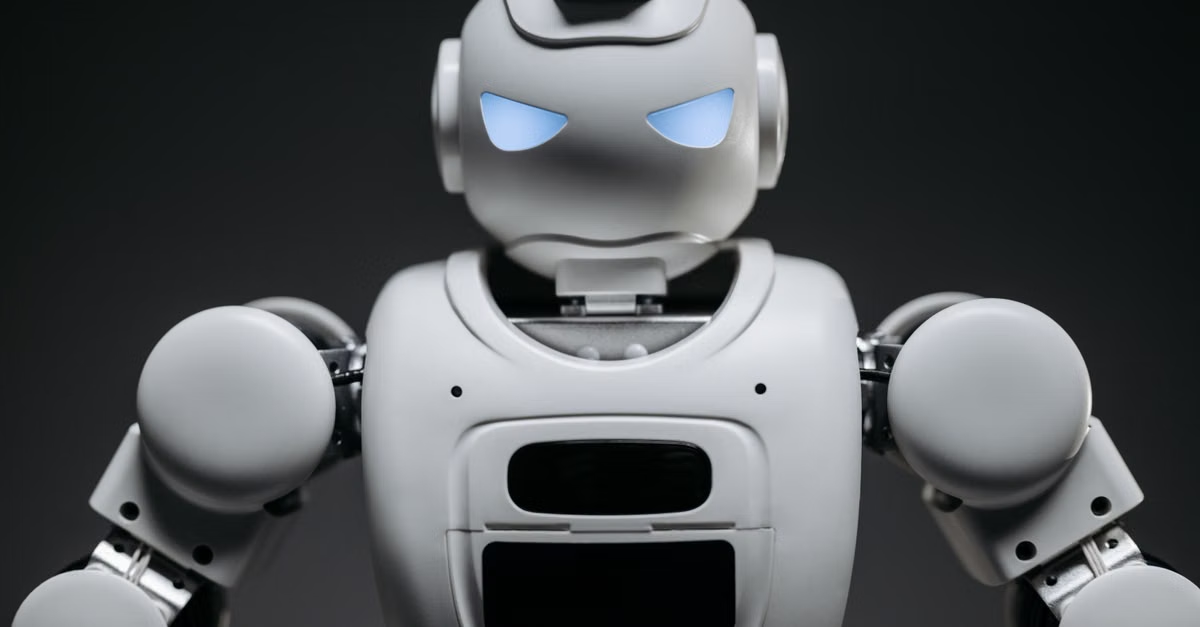
Robots and the future of automation in 2026 are no longer about distant promises; physical hardware paired with adaptable AI models is actively changing factory floors, warehouses, and hospital corridors. We have moved past the era where a robot could only repeat one hardcoded movement ten thousand times a day without stopping.
Today, machines adapt to unexpected obstacles, pick up unfamiliar items, and work directly alongside people without heavy protective cages.
If you watched the news a few years ago, you might have expected walking, talking robot butler servants in every home by now. That did not happen. Instead, the real revolution quietly took over practical, industrial spaces.
Let’s break down what is actually happening on the ground today, where the technology excels, and where it still hits a wall.
How Are AI and Physical Robots Finally Merging?
For decades, robotics and artificial intelligence developed on two separate tracks. Computer scientists built software that could analyze text or recognize faces, while mechanical engineers built steel arms that followed rigid geometric paths.
Now, those two worlds have merged.
Traditional Industrial Bots             Modern Autonomous Systems
[ Fixed Code ] -> [ Spatial Path ]      [ Camera / Sensor Feed ] -> [ AI Model ] -> [ Dynamic Action ]
(Fails if object moves 1 cm)            (Adjusts grip automatically in real time)
The Shift from Rigid Scripts to Vision-Language-Action Models
In the past, if a package on a conveyor belt shifted two inches to the left, a standard industrial arm would attempt to grab empty air. Fixing that meant paying an engineer to rewrite code or adjust physical guides.
Today, advanced systems use Vision-Language-Action (VLA) models.
Consider Amazon’s latest sorting arms deployed across fulfillment centers. Armed with dynamic visual sensors, these machines process unsorted totes filled with thousands of different products. A machine can spot a soft tube of toothpaste lying across a hard plastic video game case, instantly evaluate the grip strength needed for both, and pick them up sequentially without crushing either item.
No pre-programming required. The system sees, understands, and reacts in real time.
Why Humanoid Hype Is Meeting Practical Reality
You cannot look at news about robots and the future of automation without seeing bipedal humanoids walking through demos. Companies like Figure, Boston Dynamics, and Tesla dominate social media feeds with videos of machines pouring coffee or lifting boxes.
Here is the candid truth: most of those videos are heavily edited or staged in tightly controlled environments.
Real-World Reality Check: Bipedal legs are expensive, energy-hungry, and mechanically complex. While humanoids like the Figure 02 show massive promise for environments explicitly designed for humans—like climbing narrow stairs or reaching high shelves—wheeled or stationary bases remain far cheaper, more stable, and more energy-efficient for 90% of industrial tasks right now.
Which Industries Are Seeing the Biggest Shifts Right Now?
Automation is not hitting every sector at the same pace. Some fields are transforming overnight, while others are hitting massive technical bottlenecks.
| Industry | Primary Automation Use Case | Current Maturity Level | Biggest Barrier |
| Logistics & Warehousing | Autonomous Mobile Robots (AMRs), parcel sorting | High | Managing mixed, chaotic inventory |
| Manufacturing | Collaborative arms (Cobots), quality inspection | Very High | Legacy equipment integration |
| Healthcare | Surgical assistance, pharmacy dispensing | Medium | High regulatory compliance & cost |
| Retail & Hospitality | Floor scrubbing, shelf auditing, basic delivery | Low to Medium | Customer interaction edge cases |
Logistics and Warehousing: Beyond Fixed Conveyor Belts
Warehouses used to rely on massive, bolted-down conveyor belts that took millions of dollars and months of construction to set up. If your logistics needs changed, you were stuck.
Now, Autonomous Mobile Robots (AMRs) dominate facilities run by companies like DHL and FedEx. These small, low-profile machines scan the floor with LiDAR, mapping out the facility on their first run.
If an employee drops a clipboard in an aisle, the AMR simply routes around it. If holiday demand spikes in sector B, you do not rebuild the warehouse—you just reassign fifty bots through a software dashboard.
Manufacturing: Collaborative Bots on the Factory Floor
Traditional industrial robots will break your arm if you get in their way. That is why they operate inside interlocked steel cages.
Collaborative robots, or “cobots,” changed that dynamic entirely.
Take Universal Robots’ UR20 arm, currently used in automotive sub-assembly plants. It uses force-torque sensors to monitor every joint. If a worker leans against the arm while it holds a heavy panel, the machine detects the force spike and stops within milliseconds.
Instead of replacing human workers, these cobots take over repetitive tasks—like applying uniform sealant around a windshield—while the technician focuses on precise wiring assembly right beside it.
Healthcare and Service: Where Robots Help (and Where They Fail)
In healthcare, surgical systems like the Intuitive Da Vinci system do not operate autonomously. Instead, they act as ultra-precise extensions of a surgeon’s hands, eliminating tremors during delicate operations like prostatectomies or cardiac valve repairs.
On the floor, specialized delivery units like the Aethon TUG roll down hospital hallways delivering medication from the central pharmacy to nurse stations.
Where do they fail? Simple service interactions.
Restaurants that bought robot waitstaff during labor shortages found out quickly that customers get frustrated when a tray-carrying unit stops completely because a child backed into its path, creating a traffic jam in the dining room. High-variance public spaces remain a tough puzzle for basic automation.
How Is the Workforce Adapting to Robots and the Future of Automation?
The headline question is always the same: Will a robot take my job?
The answer is nuanced. Automation rarely eliminates entire job titles overnight. Instead, it strips away specific tasks within those jobs—usually the dirty, dangerous, or repetitive ones.
The Reality of Job Displacement vs. Job Reskilling
Look at a typical automotive body shop. Twenty years ago, teams of workers held heavy spot-welding guns for eight hours a day, suffering chronic shoulder injuries and breathing toxic fumes.
Today, automated welding stations handle that physical burden.
Does that mean the team was fired? In most well-managed plants, no. Those line workers were retrained to become automation technicians, monitor sensor readouts, calibrate robotic tips, and handle preventative maintenance.
Here is what the shift looks like in practice:
-
Task Automation: The physical task (welding, lifting, sorting) moves to the machine.
-
Role Elevation: The human worker shifts from performing the task to supervising the machine.
-
Skill Upgrade: The worker learns basic diagnostics, software interfaces, and mechanical troubleshooting.
What Skills Will Matter Over the Next Five Years?
If you work in an industry being touched by automation, pure manual speed is no longer job security.
Instead, value relies on these key capabilities:
-
Basic System Diagnostics: Understanding how to read error logs, clear physical jams, and restart software nodes.
-
Domain Expertise: Knowing why a part needs to fit a certain way so you can teach or calibrate the machine properly.
-
Adaptability with Software: Comfortably using tablet-based programming tools (like teaching a cobot pathing by manually guiding its wrist).
What Are the Biggest Roadblocks Stalling Widespread Adoption?
Despite the rapid progress, we are far from a fully automated world. Three major bottlenecks keep companies from deploying robots at scale:
1. High Upfront Capital Costs
A single high-end industrial arm with optical vision sensors and safety features can easily run $80,000 to $150,000 before installation. For small to mid-sized manufacturers operating on tight margins, that payback period can feel too risky.
2. The “Long Tail” of Edge Cases
Robots love predictability. The real world is messy.
A glare from an unexpected afternoon sunbeam off a shiny metal floor can blind an optical sensor. A crushed cardboard box corner can confuse a vacuum gripper. Solving 90% of automated tasks is relatively easy now—solving that last 10% of weird real-world edge cases costs millions.
3. Legacy Infrastructure
You cannot easily drop a state-of-the-art AMR into a 50-year-old warehouse with uneven concrete floors, narrow doors, and zero Wi-Fi coverage. Upgrading the facility often costs more than buying the actual robots.
So, where does that leave us?
The future of automation is not a sudden sci-fi movie overhaul. It is a steady, practical integration of smarter tools that make hard work safer and faster.
FAQ Section
Will robots replace most human factory workers by 2030?
No. While robots will take over more physical and repetitive tasks like palletizing and welding, factories still face major talent shortages for roles that require complex decision-making, maintenance, and oversight. The overall trend points toward human-robot collaboration rather than total replacement.
What is the primary difference between traditional industrial robots and cobots?
Traditional industrial robots are designed to operate at high speeds inside protective enclosures, isolated from humans for safety. Collaborative robots (cobots) feature built-in force sensors, rounded edges, and speed limitations that allow them to safely work directly alongside human operators without safety cages.
How are AI vision systems changing robotics today?
AI vision systems allow robots to recognize, analyze, and manipulate unorganized or varied objects in real time. Instead of requiring items to be placed in an exact position on a structured line, modern bots use camera feeds and neural networks to pick up items of different shapes, sizes, and orientations automatically.
What is keeping humanoid robots out of most everyday workplaces?
High manufacturing costs, limited battery life (often under two hours of continuous heavy operation), and mechanical complexity keep humanoids from widespread commercial use today. Fixed arms and specialized wheeled bases remain significantly cheaper and more efficient for specific industrial tasks.
Conclusion
The defining shift in modern automation is adaptability: machines no longer just follow blind instructions; they perceive their environment and react intelligently. If you want to stay ahead as a professional or business owner, stop worrying about humanoid hype and start focusing on practical human-robot collaboration in your immediate industry.
For more, visit Izonemedia360.news.