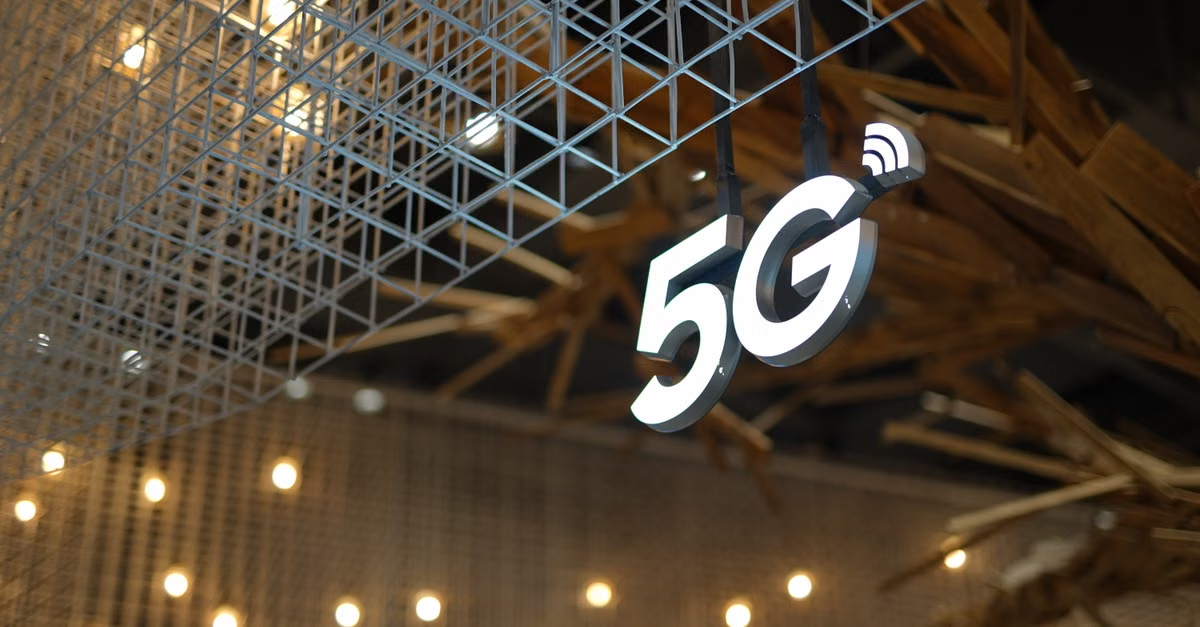
How 5G expansion fuels global network infrastructure determines how fast cities, factories, and everyday consumers transition to high-speed, low-latency communication. The worldwide deployment of mid-band spectrum, small cell installations, and standalone core architectures directly converts theoretical mobile speeds into real-world utility.
Forget the early carrier commercials showing people downloading movie franchises in four seconds while standing on a downtown street corner. That was the initial millimeter-wave pitch, and frankly, it missed the point. If you stepped behind a single brick wall or walked fifty feet down an alley, that signal dropped back to 4G LTE.
Real connectivity progress happens behind the scenes through systematic network builds. Telecom companies are putting money where it counts: mid-band spectrum, fiber-optic backhaul, and localized edge compute nodes. Here is how that buildout actually affects your tech, your job, and your daily life.
What Does 5G Expansion Actually Look Like Today?
Rolling out a global network upgrade is not as simple as flipping a switch at a central station. It requires physical hardware installed on thousands of street poles, buildings, and rural towers.
       [ 5G Network Architecture ]
                    │
   ┌────────────────┼────────────────┐
   ▼                ▼                ▼
Low-Band        Mid-Band         High-Band
(700-900 MHz)   (2.5-3.7 GHz)    (24-39 GHz)
Wide Area       Sweet Spot       Short Range
Base Coverage   Speed + Range    Gigabit Speeds
Mid-Band Spectrum: The Sweet Spot of Coverage
Initial rollouts suffered because providers relied heavily on low-band spectrum (great coverage, slow speeds) or high-band millimeter wave (blazing fast, terrible range).
The sweet spot sits right in the middle. Mid-band spectrum—typically between 2.5 GHz and 3.7 GHz—delivers sustained download speeds between 100 Mbps and 400 Mbps over long distances. When T-Mobile acquired Sprint, they grabbed a massive chunk of 2.5 GHz spectrum, giving them an early lead in usable coverage across North America. Verizon and AT&T spent tens of billions acquiring C-band rights to catch up, spent years deploying radio units, and are now seeing those investments pay off.
Small Cells vs. Massive Towers
Traditional cellular networks relied on massive towers spaced miles apart. Modern infrastructure takes a different route.
Instead of relying solely on 100-foot towers, carriers install thousands of “small cell” units on light poles, traffic signals, and sides of commercial buildings. In dense areas like Chicago or London, you might pass five small cell nodes on a single city block. Each node covers a small area, handling heavy data loads without clogging the broader network.
Why 5G Expansion Fuels Real Economic and Technological Growth
We often hear about autonomous cars and remote surgery, but where is the actual impact happening right now?
┌─────────────────────────────────────────────────────────────┐
│                 5G Practical Capabilities                   │
├──────────────────────┬──────────────────────────────────────┤
│ Metric               │ Typical Value                        │
├──────────────────────┼──────────────────────────────────────┤
│ Latency              │ 10 ms to 20 ms (Real-world)          │
│ Average Mobile Speed │ 150 Mbps to 350 Mbps                 │
│ Connection Density   │ Up to 1,000,000 devices per km²      │
└──────────────────────┴──────────────────────────────────────┘
Industrial Automation Beyond the Marketing Hype
Factories are cutting physical network cables.
At a Hyundai manufacturing facility in Singapore, automated guided vehicles (AGVs) transport heavy components across the shop floor. On a legacy Wi-Fi setup, those AGVs occasionally stall whenever they switch between wireless access points. A private 5G network fixes that problem. With latency staying consistently under 15 milliseconds, the vehicles move constantly without signal drops or dangerous collision delays.
Healthcare and Remote Surgery: Reality or Distant Dream?
Let’s clear up a common misconception. Surgeons are not performing heart operations on patients miles away over a basic phone connection from their couches.
What is happening, however, is real-time high-definition imaging transmission. During complex procedures, specialists view live 4K video feeds and telemetry data from remote clinics without delay. A specialist in Boston can guide a surgical team in rural Maine through a complex laparoscopy because the data feed doesn’t freeze or drop frames.
How Does 5G Compare to 4G in Real-World Scenarios?
The real difference isn’t just raw speed—it’s capacity and response time.
| Feature | 4G LTE Networks | Modern Expanded 5G |
| Typical Download Speeds | 20 – 50 Mbps | 150 – 400 Mbps |
| Average Latency | 50 – 100 ms | 10 – 25 ms |
| Capacity Per Tower | ~4,000 devices per km² | Up to 1,000,000 devices per km² |
| Network Core | Centralized hardware | Software-defined & edge-based |
| Primary Limitation | Congestion in crowds | High infrastructure setup cost |
Think of 4G like a four-lane highway during rush hour. It works fine until too many cars try to use it at once.
5G expands that highway to twenty lanes while adding dedicated express lanes for specific traffic types—a process called network slicing.
Real-World Impact: If you have ever tried sending a text message at a packed stadium holding 70,000 fans, you know 4G chokes under pressure. A properly configured network slice lets emergency responders keep a guaranteed, high-priority connection on the exact same physical infrastructure that stadium fans use to post video clips.
What Is Blocking Faster 5G Rollouts?
If these networks are so great, why isn’t every acre of the planet covered yet?
Here’s the thing: running fiber is expensive, messy, and slow.
       [ Core Infrastructure Challenges ]
                       │
       ┌───────────────┴───────────────┐
       ▼                               ▼
Physical Backhaul               Zoning & Permits
(Requires thousands of          (Complex municipal approvals
 miles of optical fiber)         and local opposition)
High Capital Expenditure and Fiber Backhaul Demands
Every wireless cell node needs a wired backhaul connection. You can have the advanced radio antenna on earth, but if it connects to a slow copper wire, your performance plummets.
Carriers have to dig up streets, lay hundreds of thousands of miles of high-capacity optical fiber, and wire each small cell directly into the national grid. That takes billions of dollars cash upfront before a single customer pays for service.
Regulatory Hurdles and Local Zoning Issues
Local politics slow down technology faster than technical glitches do.
-
Municipal permitting processes can take months per pole location.
-
Historical district restrictions ban physical modifications to public structures.
-
Neighborhood boards frequently oppose small cell installations near residential homes.
In cities like San Francisco or Paris, securing approval for a single antenna site involves navigating public hearings, environmental impact reviews, and structural safety checks. Multiply that process by 10,000 sites, and you understand why nationwide coverage takes years to build out.
How Can Businesses Prepare for Next-Generation Networks?
If you run an organization, waiting until old infrastructure stops working is a mistake.
First, audit your current hardware. Older IoT sensors, point-of-sale systems, and industrial gateways often rely on legacy wireless standards. When carriers shut down older 3G and shift capacity away from basic 4G, those devices lose connectivity entirely.
Second, evaluate private network setups. If you manage a warehouse, port, or large office campus, relying on public carrier connections leaves you vulnerable to regional outages. Setting up a localized private network gives you total control over security, bandwidth allocation, and data privacy.
So, where do we go from here?
The goal isn’t just showing a fancy icon at the top of your smartphone screen. The real point of this buildout is creating reliable, high-capacity infrastructure that works quietly, instantly, and continuously in the background.
FAQ
What is the primary benefit of 5G over older network generations?
The biggest advantage is a combination of higher bandwidth and significantly lower latency. While 4G typically responds in 50 milliseconds, modern networks respond in 10 to 20 milliseconds, allowing real-time responses for industrial automation, gaming, and critical infrastructure.
Does 5G replace home broadband internet connections?
Yes, for many households. Fixed Wireless Access (FWA) uses carrier networks to deliver high-speed internet directly to a home receiver, providing a competitive alternative to traditional cable and DSL providers in suburban and rural areas.
How does weather affect high-frequency network signals?
High-frequency signals, such as millimeter-wave, can be degraded by heavy rain, foliage, and physical structures like concrete walls. Mid-band frequencies balance range and signal penetration much better, minimizing weather disruptions.
Is a private network different from a public mobile plan?
Yes. A private network uses dedicated radio equipment and spectrum assigned exclusively to one facility, such as a factory, hospital, or shipping port. This keeps internal data completely isolated from public traffic while guaranteeing dedicated bandwidth.
Conclusion
The true value of network expansion isn’t download speeds on a phone—it is the reliable, low-latency foundation it creates for automation, smart cities, and modern industry. Focus on upgrading your infrastructure to support edge capabilities today, because high-density networks are quickly becoming the baseline requirement for digital operations.
For more, visit Izonemedia360.news.